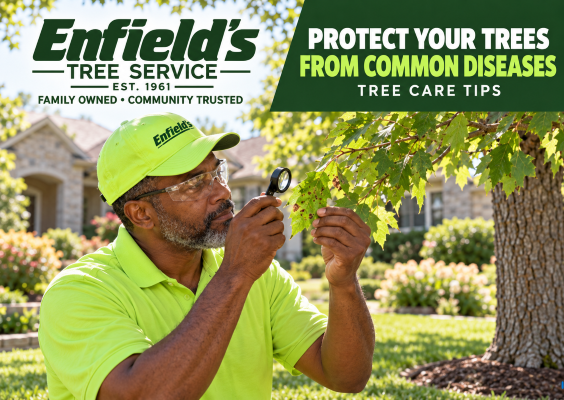
- Check Your Trees Often
Take a few minutes to look at your trees throughout the year. Look at the leaves, branches, trunk, and roots.
Watch for yellow or brown leaves, dead branches, spots on leaves, unusual growth, holes, peeling bark, or mushrooms near the base of the tree.
Finding a problem early may make it easier to treat. - Keep Trees Watered
Trees need water to stay healthy, especially during dry weather. Young trees often need more help than established trees.
Water the soil around the tree instead of spraying the trunk and leaves. Water slowly so the moisture can soak into the ground and reach the roots.
Avoid watering too much. Soil that stays wet for a long time can also cause tree problems. - Add Mulch Around the Tree
Mulch can help protect tree roots and hold moisture in the soil. It can also help keep weeds away from the tree.
Spread mulch around the base of the tree, but do not pile it against the trunk. Keep the trunk clear so it can stay dry and healthy. - Trim Dead and Damaged Branches
Dead and broken branches can create places for insects and disease to enter the tree. Removing damaged branches may help protect the rest of the tree.
However, tree trimming should be done with care. Cutting the wrong branch can cause more damage.
A professional can help determine which branches should be removed. - Protect the Tree Roots
Tree roots can be damaged by digging, construction, heavy equipment, and changes in the soil.
Try to avoid driving or parking heavy equipment over the root area. Be careful when digging near trees.
Healthy roots are important because they help support the tree and provide water and nutrients. - Watch for Insects
Insects can weaken trees and may help spread disease. Look for holes, sawdust, damaged leaves, unusual bumps, or insects on the bark.
If you see something unusual, do not automatically spray the tree. The right treatment depends on the insect and the tree. - Get Professional Tree Care
Some tree diseases are hard to identify. What looks like an insect problem may actually be a disease, soil problem, or other tree issue.
A Certified Arborist can inspect the tree and help find the cause of the problem. Enfield’s Tree Service can also provide professional tree care, including systemic spraying and fertilizing and systemic injection when appropriate.
Early treatment may help protect a valuable tree and prevent problems from becoming worse. - Remove Seriously Damaged Trees
Sometimes a tree is too sick or damaged to save. A dead or badly diseased tree can become a safety risk.
If a tree cannot be saved, professional removal may be the safest choice. Do not assume that removing a tree yourself is a simple job.